1What is hotel revenue management software?
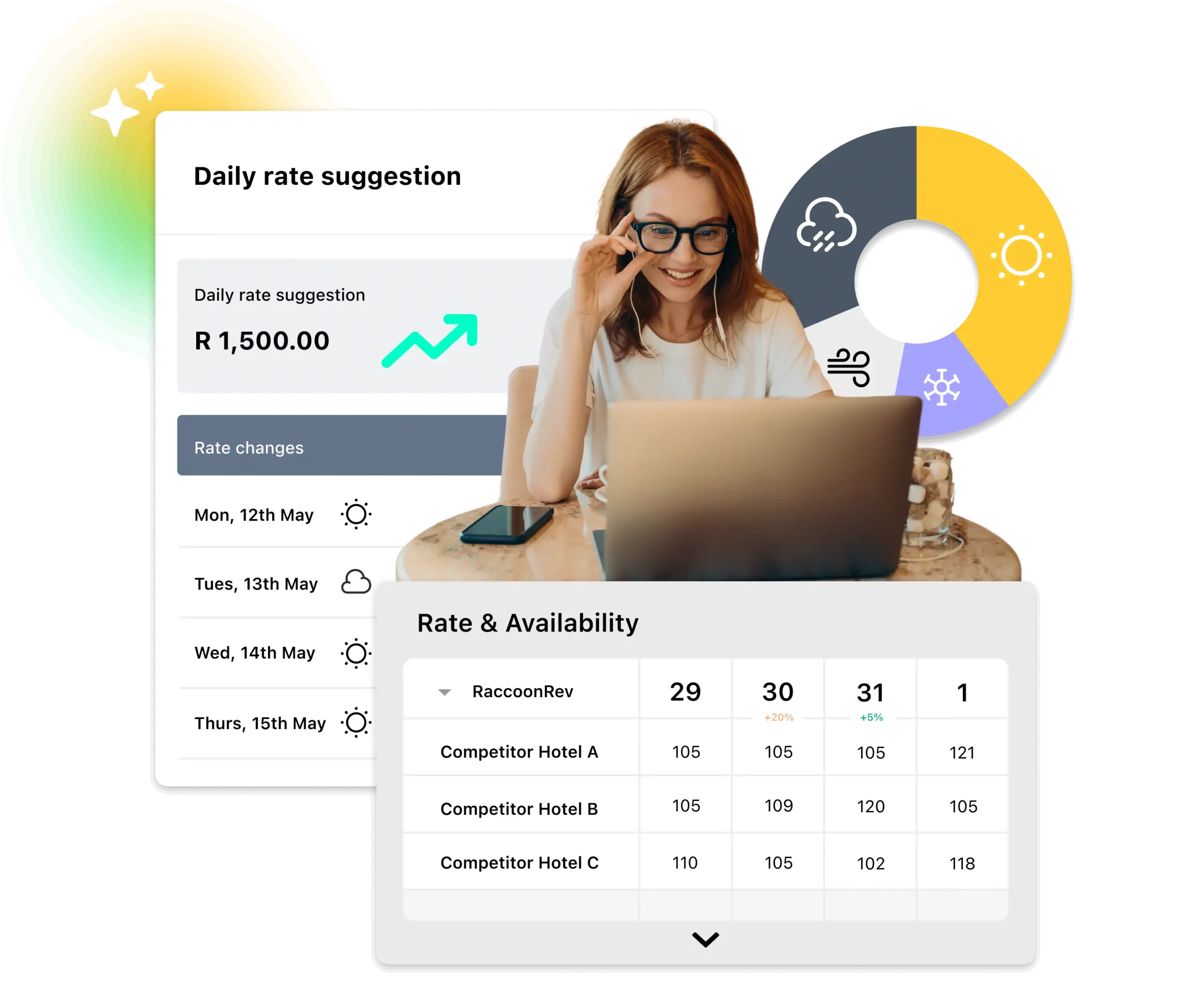
Hotel revenue management software is a system that helps hotels, lodges, and guesthouses optimise pricing and room availability based on demand, booking patterns, and market conditions. Instead of using static seasonal rates, the software analyses occupancy, booking pace, and competitor pricing to guide dynamic rate adjustments. It usually integrates with a Property Management System (PMS), Channel Manager, and Booking Engine so pricing decisions immediately affect all sales channels, helping accommodation businesses increase RevPAR, manage inventory more strategically, and respond faster to market fluctuations.
2How does revenue management differ from a Property Management System (PMS)?
A Property Management System manages operational hotel tasks such as reservations, room status, guest profiles, and housekeeping coordination. Revenue management focuses specifically on pricing strategy, demand forecasting, and revenue optimisation. While the PMS records booking activity, revenue management tools analyse that data to determine optimal room rates and availability rules. When connected, these systems enable hotels to align daily operations with commercial strategy, ensuring that pricing, availability, and occupancy decisions are based on real-time operational data.
3Why is revenue management important for hotels and guesthouses in South Africa?
Revenue management is important in South Africa because demand fluctuates strongly between high tourist seasons, domestic travel periods, and local events. Hotels and guesthouses that rely on fixed rates often miss opportunities to maximise revenue during peak demand or protect occupancy during slower periods. By analysing booking trends, lead times, and market signals, revenue management allows accommodation businesses to balance occupancy and price more effectively, making their operations more resilient in a competitive tourism environment.
4What does dynamic pricing mean in the hospitality industry?
Dynamic pricing refers to adjusting room rates continuously based on demand, booking behaviour, and market conditions rather than using fixed price lists. Hotels may increase prices when demand rises or lower them when occupancy forecasts decline. This strategy considers variables such as competitor rates, local events, length of stay, and booking pace. Dynamic pricing is a central principle of revenue management because it helps accommodation providers capture the highest possible revenue for each room night.
5Which key performance indicators are essential in hotel revenue management?
Key performance indicators in revenue management include Average Daily Rate (ADR), occupancy rate, Revenue per Available Room (RevPAR), booking pace, lead time, and channel mix. These metrics help hoteliers understand whether revenue growth comes from higher prices, stronger demand, or better distribution strategies. Monitoring these indicators together provides a clearer picture of performance, enabling accommodation businesses to refine pricing strategies, evaluate distribution channels, and forecast demand more accurately.
6How does a Channel Manager support revenue management strategy?
A Channel Manager distributes rates and availability from a central system to multiple online sales channels such as OTAs and direct booking platforms. From a revenue management perspective, this ensures that pricing decisions are applied consistently across all distribution channels. Without automated distribution, hotels risk outdated rates, inconsistent availability, or overbookings. By synchronising inventory and pricing in real time, a Channel Manager supports revenue optimisation while maintaining accurate room availability across the online marketplace.
7What role does a Booking Engine play in hotel revenue performance?
A hotel Booking Engine is the technology that enables guests to make reservations directly on a property’s website. Within a revenue management strategy, the Booking Engine helps increase direct bookings, which usually carry lower distribution costs than OTA reservations. By controlling pricing, availability, and upsell options within the direct booking path, hotels can influence guest purchasing decisions while maintaining stronger profit margins and collecting valuable guest data for future marketing and forecasting.
8How does automation improve revenue management for accommodation businesses?
Automation in revenue management allows pricing rules, demand signals, and inventory updates to be applied automatically across systems and sales channels. Instead of manually adjusting rates and availability multiple times per day, hotels can rely on automated pricing logic to react quickly to changes in occupancy, market demand, or competitor pricing. This reduces operational workload while ensuring that pricing decisions remain consistent, timely, and aligned with broader commercial strategy.
9When should a hotel or lodge start using revenue management software?
Hotels typically benefit from revenue management software once manual pricing decisions become difficult to manage across multiple channels, room types, or rate plans. Properties experiencing fluctuating demand, growing OTA distribution, or increased direct booking traffic often reach a point where spreadsheets and static pricing strategies are insufficient. At that stage, revenue management tools provide structure, automation, and analytical insight that support more consistent pricing decisions and stronger financial performance.
10How does revenue management software use market and demand data?
Revenue management software analyses internal booking data alongside external market indicators to guide pricing decisions. Internal data may include occupancy levels, booking pace, cancellation trends, and room category performance. External signals often include competitor pricing, local demand patterns, and regional tourism trends. By combining these data sources, the software generates recommendations or automated adjustments that help hotels maintain competitive rates while protecting revenue during both high and low demand periods.
11What are the main benefits of integrating revenue management with hotel software systems?
Integrating revenue management with hotel software systems such as PMS platforms, Channel Managers, and Booking Engines ensures that pricing decisions influence every stage of the booking process. Integration eliminates duplicated data entry, reduces the risk of rate discrepancies across channels, and improves the reliability of performance reporting. When operational and commercial data flow through a unified system, hotels gain clearer insights into demand patterns and can respond more quickly to market changes.
12How can hotels balance OTA distribution with direct bookings through revenue management?
Revenue management helps hotels balance OTA exposure with direct bookings by controlling inventory allocation, pricing structures, and availability restrictions across channels. Rather than depending entirely on third-party marketplaces, hotels can adjust rates and inventory to encourage direct reservations during periods of strong demand. At the same time, OTAs remain valuable distribution partners during slower periods. Strategic revenue management therefore improves channel mix and protects overall profitability.
13What costs are associated with implementing revenue management software?
Costs typically include the monthly software subscription, onboarding and system configuration, staff training, and integration with existing hotel systems. Some properties may also invest time in restructuring rate plans, cleaning historical booking data, and aligning operational workflows before implementation. When evaluating cost, hotels should consider the potential revenue gains from improved pricing accuracy, better forecasting, and reduced manual workload rather than focusing only on the licence fee.
14How long does it take to implement revenue management technology in a hotel?
Implementation timelines depend on the size of the property, the number of room types, distribution channels, and integrations required. A smaller guesthouse with a simple rate structure can often configure the system relatively quickly, while larger hotels with complex inventory rules may require more preparation. Typical implementation steps include system configuration, data migration, channel connections, and staff training to ensure pricing and availability updates operate correctly across all platforms.
15What data protection regulations affect hotel software in South Africa?
Hotels in South Africa must comply with the Protection of Personal Information Act (POPIA), which regulates how personal data is collected, stored, and processed. Accommodation providers handle sensitive guest information such as identification details, payment records, and contact data. Revenue management and hotel software platforms must therefore support secure data storage, controlled access, and responsible data processing practices to ensure compliance with POPIA and maintain guest trust.
16How does VAT influence pricing strategies for accommodation providers in South Africa?
VAT influences hotel pricing because accommodation services are generally subject to the standard South African VAT rate. Hotels must decide whether displayed rates include or exclude VAT and ensure that accounting, invoices, and reporting systems correctly reflect tax obligations. Revenue management systems therefore need to support tax-inclusive pricing logic and accurate financial reporting so that pricing strategies remain profitable after tax considerations.
17Can revenue management software support long-stay and short-stay pricing strategies?
Revenue management software can support different pricing models for varying lengths of stay by applying rules such as minimum stay restrictions, discounts for extended bookings, or premium pricing for short stays during high demand. This flexibility allows hotels to align pricing with operational costs and demand patterns. For example, longer stays may reduce housekeeping turnover, while short stays during peak periods can justify higher nightly rates.
18Which payment methods are important for hotel bookings in South Africa?
Accommodation providers in South Africa typically need to support a mix of payment methods including credit cards, debit cards, and bank-based options such as electronic funds transfers or instant EFT. Flexible payment options improve booking conversion and accommodate both international travellers and domestic guests. Integrated payment systems also simplify deposit handling, refund processing, and financial reconciliation within the broader hotel software environment.
19How do cancellations and no-shows affect revenue management decisions?
Cancellations and no-shows influence revenue management because they affect forecast accuracy and available inventory. Hotels that track cancellation behaviour by booking channel, rate plan, and lead time can adjust deposit policies, cancellation windows, and pricing strategies accordingly. Understanding these patterns helps accommodation providers reduce revenue loss from last-minute cancellations while maintaining fair booking policies that encourage guest confidence.
20What common mistakes should hotels avoid when adopting revenue management systems?
Common implementation mistakes include poorly structured rate plans, inconsistent room category definitions, and weak integration between hotel software systems. Hotels may also underestimate the importance of staff training or expect technology to solve strategic pricing issues automatically. Successful adoption requires clear pricing policies, accurate historical data, and defined responsibilities for monitoring performance and adjusting revenue strategies after implementation.
21How does cloud-based hotel software support modern revenue management?
Cloud-based hotel software allows pricing decisions, reservation data, and performance analytics to be accessed securely from any location with internet access. This flexibility enables managers to monitor booking activity, adjust rates, and review demand trends in real time without relying on on-site servers. Cloud infrastructure also simplifies system updates and integrations, making it easier for hotels to adopt new features that support evolving revenue strategies.
22How should lodges, boutique hotels, and guesthouses adapt revenue management strategies?
Different accommodation types require tailored revenue management approaches because their booking patterns and guest expectations differ. Lodges may rely heavily on seasonal tourism and package pricing, boutique hotels often focus on room category differentiation, and guesthouses may operate with simpler rate structures. Effective revenue management adapts pricing logic to the operational reality of the property while maintaining consistent monitoring of demand trends.
23Why is demand forecasting essential in hotel revenue management?
Demand forecasting is the process of predicting future occupancy and booking behaviour using historical data, current reservations, and market indicators. Accurate forecasts help hotels plan pricing strategies, staffing levels, and marketing activities in advance. By anticipating demand rather than reacting to it, accommodation providers can optimise room rates during high demand and implement promotional strategies during slower periods.
24How can tourism grading and market positioning influence hotel pricing in South Africa?
Tourism grading and market positioning affect pricing because they shape guest expectations and perceived value. Properties with recognised quality standards or unique positioning may command higher rates, while accommodation competing primarily on price may need different revenue strategies. Revenue management systems help translate these positioning factors into practical pricing decisions by analysing demand patterns and competitor pricing within the same market segment.
25How does RoomRaccoon support revenue management for South African accommodation businesses?
RoomRaccoon provides revenue management capabilities within an integrated hotel software platform that connects pricing tools with a PMS, Channel Manager, Booking Engine, and payment infrastructure. By linking these functions in a single cloud system, accommodation providers can automate rate updates, distribute availability across channels, and analyse performance data in one environment. This integrated approach helps South African hotels and guesthouses manage pricing strategy, improve operational efficiency, and respond faster to changing market demand.