1What is a property management system (PMS) in the South African hospitality industry?
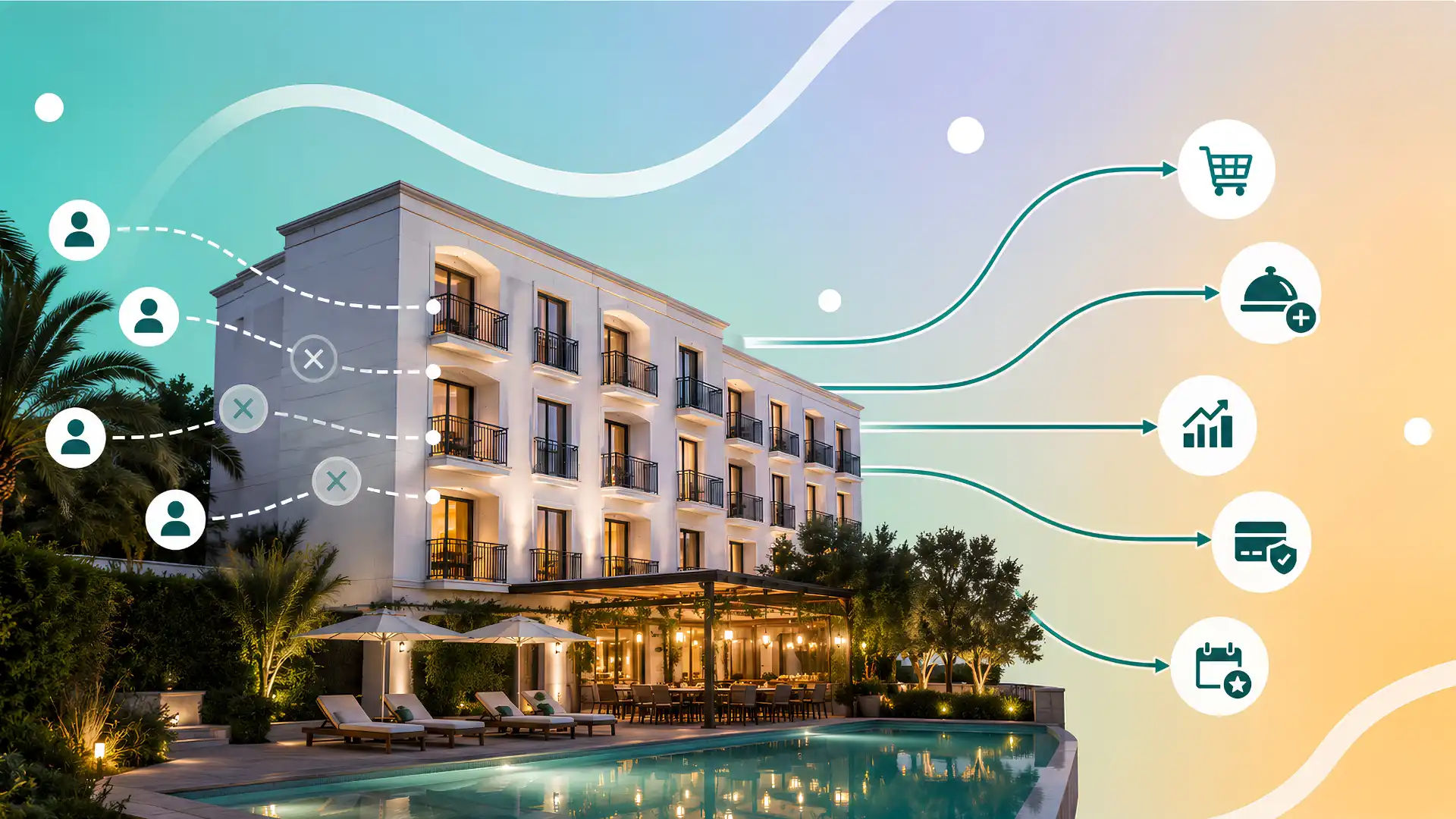
A property management system (PMS) is central hotel software that manages reservations, room inventory, guest profiles, billing, housekeeping, and reporting within one unified platform. In the South African hospitality context, a PMS typically operates as cloud software and connects with a Channel Manager, Booking Engine, and payment systems. This centralisation allows accommodation providers to control operations, reduce manual processes, and maintain consistent data across front office, distribution channels, and financial workflows.
2How does a PMS differ from basic hotel front desk software?
Hotel front desk software focuses primarily on reception tasks such as check-in, check-out, and room allocation, while a PMS extends across the full operational ecosystem. A PMS includes reservations, reporting, housekeeping coordination, guest communication, and integrations with Channel Managers and Booking Engines. For South African operators, this broader scope is critical because managing multiple booking channels, payments, and reporting requirements requires more than just front-desk functionality.
3Why do South African hotels, guesthouses, and lodges need a PMS?
A PMS enables accommodation businesses to centralise operations, reduce administrative workload, and improve accuracy across bookings and guest management. In South Africa, where many properties operate with lean teams and rely on both OTA and direct bookings, a PMS reduces duplication and errors. It also supports better guest communication, faster processing of reservations, and improved operational visibility, which is essential for maintaining service quality and profitability in competitive tourism markets.
4What core features should a modern hotel PMS include?
A modern PMS should include reservation management, a real-time availability calendar, guest profiles, invoicing, rate management, reporting, and housekeeping coordination. It should also integrate with a Channel Manager and Booking Engine to synchronise rates and availability across OTA platforms and direct booking channels. In South Africa, essential features also include payment tracking, VAT-compatible invoicing, and cloud accessibility to support flexible operations and remote management.
5How does cloud-based PMS software improve operational efficiency?
Cloud-based PMS software enables real-time access to reservations, rates, and guest data from any device, reducing dependency on on-site systems and manual updates. Changes made in one area instantly reflect across the system, improving coordination between departments. For South African properties, especially those with remote management or multiple locations, cloud software enhances flexibility, reduces IT maintenance, and ensures that staff always work with up-to-date information.
6How does a PMS integrate with a Channel Manager and OTA platforms?
A PMS integrates with a Channel Manager to distribute room availability and pricing to OTA platforms such as Booking.com and Expedia. When a booking is made, the Channel Manager sends it back to the PMS, updating availability automatically. This two-way synchronisation reduces overbookings and eliminates manual updates. In South Africa, where OTA reliance is high, this integration is essential for maintaining accurate inventory and maximising occupancy across multiple sales channels.
7What is the role of a Booking Engine within a PMS ecosystem?
A Booking Engine is the direct booking interface on a hotel’s website that connects to the PMS to display real-time availability and rates. It allows guests to book directly without using third-party platforms. When integrated properly, the Booking Engine ensures that all bookings are automatically recorded in the PMS. For South African properties, this supports higher-margin direct bookings and reduces dependency on OTA commissions.
8How does a PMS help prevent overbookings and pricing errors?
A PMS prevents overbookings by synchronising room availability across all channels through its integration with a Channel Manager. It also ensures that rate updates are applied consistently, reducing pricing discrepancies. In fast-changing demand environments such as holiday seasons or events in South Africa, this automation is critical. It eliminates manual updates, minimises human error, and ensures that only available rooms are sold at the correct rates.
9How does a PMS support revenue management strategies?
A PMS supports revenue management by providing data on occupancy, booking pace, lead time, and channel performance. This allows hoteliers to adjust pricing dynamically and optimise rate strategies. Some systems also enable automated pricing rules. In South Africa, where demand fluctuates based on tourism seasons and local events, a PMS helps operators maximise revenue per available room while maintaining competitive pricing across different distribution channels.
10What reporting capabilities should a PMS provide for South African hoteliers?
A PMS should provide detailed reports on occupancy rates, average daily rate, revenue, booking sources, and guest behaviour. It should also support financial reporting, including outstanding balances and payment tracking. For South African businesses, these insights are essential for managing cash flow, planning pricing strategies, and ensuring accurate VAT reporting. Real-time dashboards and exportable reports enhance decision-making and operational transparency.
11How does a PMS improve guest communication and experience?
A PMS improves guest communication by automating confirmations, pre-arrival instructions, payment reminders, and post-stay messages. It centralises guest data, allowing personalised communication based on booking history and preferences. For South African accommodation providers serving diverse international and domestic guests, consistent communication reduces misunderstandings, improves satisfaction, and streamlines the guest journey from booking to departure.
12How does a PMS support housekeeping and operational workflows?
A PMS provides real-time room status updates, enabling housekeeping teams to see which rooms are occupied, dirty, or ready for cleaning. It improves coordination between front office and housekeeping by aligning room turnover with arrivals and departures. In South Africa, where properties often operate with limited staff, this efficiency helps ensure faster room readiness, reduces delays, and maintains consistent service standards.
13What payment methods and integrations are important in South Africa?
South African accommodation businesses require support for card payments, EFT, payment links, and OTA virtual cards. A PMS should integrate with payment providers to automate transactions, track deposits, and manage outstanding balances. Flexibility is important because both local and international guests use different payment methods. Integrated payment workflows reduce reconciliation errors and streamline financial operations within the PMS.
14How does a PMS support VAT compliance and financial administration?
A PMS supports financial administration by generating accurate invoices, tracking payments, and consolidating revenue data. In South Africa, where VAT is set at 15%, proper recordkeeping is essential for compliance with SARS requirements. A PMS reduces manual errors and simplifies reporting by centralising financial data. This helps accommodation providers maintain accurate tax records and streamline accounting processes.
15What data protection and POPIA compliance considerations apply to PMS systems?
POPIA requires accommodation providers to protect guest data, including personal and payment information. A PMS should offer secure data storage, access controls, and compliance with data processing standards. In South Africa, this includes managing how data is collected, stored, and shared with third-party integrations. Choosing a PMS with strong security practices is essential to reduce legal risk and maintain guest trust.
16Why are integrations essential in modern hotel software ecosystems?
Integrations allow a PMS to connect with other systems such as payment providers, accounting software, revenue management tools, and guest communication platforms. Without integrations, data must be entered manually, increasing errors and inefficiency. For South African hotels, strong integrations enable a scalable and flexible technology stack that supports operational growth and adapts to changing business needs.
17What does the implementation process of a PMS involve?
PMS implementation includes configuring rooms and rates, importing reservation data, setting user permissions, integrating channels and payments, and training staff. It also involves aligning the system with existing operational processes. For South African properties, successful implementation requires clear planning, clean data, and adequate staff training to ensure smooth adoption and minimal disruption to daily operations.
18How long does it take to implement a PMS successfully?
Implementation timelines vary depending on property size, complexity, and system integrations. Smaller properties may onboard quickly, while larger or multi-property operations require more time for configuration and testing. In South Africa, the key factor is preparation, including accurate data migration and staff readiness. A structured rollout ensures that the PMS becomes the primary system for operations without causing service disruptions.
19What are the typical costs associated with a PMS?
PMS costs typically include subscription fees, implementation costs, and optional add-ons such as Channel Manager, Booking Engine, or payment integrations. Pricing varies based on property size and feature requirements. South African hoteliers should consider total cost of ownership, including training and transaction fees, rather than focusing only on monthly pricing. A cost-effective PMS balances functionality with operational efficiency gains.
20How can hotels measure the ROI of a PMS investment?
ROI is measured through improved operational efficiency, reduced manual work, increased direct bookings, fewer overbookings, and better revenue management. A PMS can also reduce administrative errors and improve reporting accuracy. For South African properties, ROI should be evaluated by comparing software costs with time savings, revenue growth, and improved occupancy performance.
21Which types of accommodation benefit most from a PMS?
A PMS benefits a wide range of accommodation types, including hotels, guesthouses, lodges, hostels, and serviced apartments. Each segment gains operational efficiency and improved booking management. In South Africa’s diverse accommodation market, a PMS helps standardise processes, improve communication, and manage multiple booking sources effectively, regardless of property size or type.
22What market-specific requirements should South African PMS solutions address?
South African PMS solutions should support local currency (ZAR), VAT compliance, diverse payment methods, and OTA integrations. They should also accommodate seasonal demand patterns and mixed guest demographics. Cloud access and mobile usability are important due to remote management needs. These features ensure that the PMS aligns with the operational and financial realities of the local hospitality market.
23How does a PMS support multi-property management and scalability?
A PMS enables centralised control over multiple properties by standardising reservations, reporting, and user access. It allows operators to manage inventory and performance across locations while maintaining individual property settings. In South Africa, where operators may manage different property types across regions, scalability ensures consistent operations and efficient expansion without increasing administrative complexity.
24What are common mistakes when choosing a PMS?
Common mistakes include prioritising low cost over functionality, ignoring integration capabilities, underestimating training requirements, and overlooking compliance with POPIA. Another mistake is choosing software that cannot scale with business growth. South African accommodation providers should evaluate systems based on operational fit, long-term usability, and ability to integrate with existing tools.
25How should South African hoteliers evaluate RoomRaccoon as a PMS solution?
RoomRaccoon is positioned as an all-in-one platform combining PMS, Channel Manager, Booking Engine, and payment functionality. South African hoteliers should evaluate how well it aligns with their operational workflows, booking channels, payment processes, and reporting needs. A practical evaluation includes testing daily tasks, assessing automation capabilities, and determining whether the system reduces manual work while improving overall operational efficiency.